May 17, 2012

Contextual Linking: Your web site is NOT a strip mall

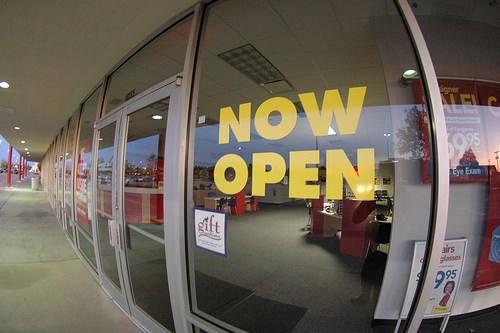
Stripmall

How stupid would it be to buy or build a giant strip mall and put different departments of your business into each storefront? How stupid would it be to not put the department names on the doors, or not tell the customer service employees inside the store where the other departments were located, instead requiring shoppers to come back to the main (home) storefront to get directions to each department? Can we agree that would be the dumbest way to build a business?

I had someone tell me the story of their web site the other day and they had done a lot of things right. They have a great design, built on a solid platform with all of the proper technical features. They got a domain that perfectly matched their biggest target keyword phrase. They have good traffic from the keyword. They have a ridiculously low bounce rate at around 1%. Unfortunately, they're not converting traffic to leads at more than 1%.

When I looked at the site, they had no contextual links in their copy. Other than the nav bar, there was no way for a visitor to get to any other page on the site once she had read to the bottom of a page. I'm not a huge fan of those big SEO footers, but at least that would have given a visitor another way to click through to different pages. How is this different than my doomed strip mall?

What's a contextual link? Just link on natural phrases in your copy that move people to different pages in your site. When they are skimming and scanning, they'll find the words that interest them and click. Outsiders (web "experts") who look at sites that I've put together often say they have too many links in the copy. Customers who use the same sites to solve a problem praise us for how easy it was to reach their goal. I'm siding with the customer on this one. You can build your strip mall on your own.

NOTE: There are no contextual links in this story. Don't you wish I'd included some as an example? Isn't it boring compared to other posts you've read where the writer linked all over the place? Wouldn't it make sense for me to link to examples of sites I've built? What if I've impressed you with my strip mall metaphor and you want to hire me? I guess you're on your own. You're smart. You'll figure it out, IF YOU HAVE TIME AND PATIENCE.

photo credit: DannyBen

Congratulations to the Bootstrappers!

Castlewave

Congratulations to my friends Rich Christiansen and Ron Porter, who have sold their SEO firm, Castlewave and will now proceed to take life easy until the next business-building bug starts to itch.

You may remember me writing about their book and their courses. They started Castlewave as a living case study for their book. Here's an excerpt from their blog:

As all of you know, this business was created with $5,000 to prove the principles in the book. CastleWave indeed was profitable from day one, generated over $1MM the first year at 50% margin and this past year did apx $1.4 MM. We have offices in both NYC and Utah and presently have 23 employees and apx 30 active clients ranging from smaller companies like Bank On Youself to large customers such as OpenTable and IMax.

It's been a lot of fun and quite educational enjoying their friendship and working with a few mutual clients. I can't wait to see the next chapter in their lives unfold!

Another Benefit to the Radio + Web Marketing Strategy

I've talked a fair bit about the strength of using radio (or any other off-line medium) to drive search for your business's name, or your "brand."

The primary benefit is that prospective customers will not find your competitors when they're searching for you.

Google-brand

There's another very strong benefit that I haven't mentioned. It's a bit more complex because there's not much you can do about it. It all takes place in Google's mighty brain, and on your own browser…as explained by SEOmoz.

Personalized search is now on by default. This means that every click, branded search, and expression of a "brand preference" or "brand affinity" in Google's results is likely to result in preferential biasing towards that domain in future searches. A "Google" Pontiac message during this Superbowl wouldn't just send users to their site, it would also mean that tens of millions of searchers would now be "personalized" towards that domain.

This means the more I search for your brand, the stronger your brand will show up in my own searches, on my own computer. This doesn't apply to search results across the web because it is a part of "personalized search" which is an individualized component of Google's system. It's the kind of thing that used to feel kind of creepy to us, but now that we're desensitized, and now that they aren't so blatant about it, feels ok.

Humorous sidenote…if you spend a lot of time Googling your competitors by name, you'll likely see their results go up, and your brand decline on your own computer. Frustrating? Yes. Worrisome? No.

SUGGESTION: If you dominate search results for your name, instead of telling people to "click over to acme-heating.com" start telling them to "Google Acme Heating!"

If you have a generic name like "Denver Heating and Air," this isn't likely to work for you because a search for your name will also show all of your competitors as well.

The truth is, most folks will search for your name anyway because it's easier than remembering your exact domain. Even if they do remember your domain, they're just as likely to type it into Google as they are to type it into the address bar. That's why "google" is one of the most searched phrases on Yahoo and vice-versa. Given the choice (or not knowing the alternatives) people will do the easiest thing.

So, tell them in your ads to do the easiest thing!

Here's the old Pontiac commercial they mentioned in the SEOmoz article:

Prosound: On-Hold Messaging for Smart Business Owners

We launched a new client web site last week for ProsoundUSA.com, a company that specializes in improving the phone experience of your customers. Instead of just providing "on-hold messages" and those automated attendant systems that we've all come to hate, ProsoundUSA owner Chester Hull makes it his business to learn about yours BEFORE attempting to tell you what your message should be.

Chester-HullIn fact, he takes it one step further and will evaluate how your living, breathing, real-life staff is doing on the phones. His phone evaluation service costs just $149 and if it saves just one sale, would be worth it to most businesses. Followups include not only his message writing and production, but customized phone etiquette training for your staff.

I don't normally gush like this about clients, but Chester is a kindred soul to those of us who believe that building a brand is more than just a cool logo and a funny ad. Chester knows that a brand is built only at that place where the customer's world intersects with the business's world. The phones are often the very first point of contact.

If delivering an outstanding experience to your callers is important to your business, Prosound is your first stop. Take a listen to his on-hold message samples and you'll understand how he's different. And, be sure to subscribe to Chester's on-hold marketing blog, he's got a lot to say about your phones.

About the web site…

Chester hired Wizard of Ads Partner Paul Boomer and I to re-design his old site from the ground up using our Persona-based approach. As Chester will tell you, the effort of putting up a site using this methodology is about 80% under water.

That is, we spent a great deal of time getting to understand Prosound's customers and their motivations…what points of information are important to them and in what order. Only after we understood his business, could we begin to map out pages, sketch out designs and get to the point where most web developers begin their process.

Kinda sounds like the same approach Chester takes, huh?

Here's the "after" shot of Chester's site:

Prosound-After 

And…here's what it looked like before:

Prosound-Before

Ok…let's roll the credits:

Web + Radio = Good Brand Strategy

For a local business, optimizing a web site to compete against your local, regional, national and international competitors can seem a bit daunting, to say the least.

Wouldn't it be great if your most valuable web traffic arrived at your site because they were looking for YOU and not your category? Trust me, it's great.

In your town, your name is your brand. It is built on only two variables:

Your reputation in the marketplace (built up by direct customer experience), and to a far lesser extent the anticipation of that experience that you PROMISED by your advertising

Those who think that a brand is built solely on advertising and marketing are fools. In fact, the quickest way to go out of business is to promise a lot and then deliver a lousy experience. Your reputation will tank and your advertising will accelerate this process by getting even more people to try you. All of these people will be happy to tell others how bad you are.

If your advertising does a good job of creating enough interest, people will seek you out when they need or want your product or service. They are no longer doing this in a dead-tree phone book. They are doing it on line. 

A new study released by the Radio Advertising Bureau has confirmed what I've been telling my clients for years; your best prospects will be those who search for you by name.

Simon Redican, managing director at the Radio Advertising Bureau, said: "The internet has become an incredibly important interface for customer marketing but the problem is that it also allows access to all your rival's brands which means the key challenge is to ensure that customers seek out your brand specifically – marketers are increasingly turning to offline media to direct consumers to their brands online."

The radio ads drove on average 34% of the total brand browsing for an average of 10% of the media budget which the research said means the radio spend was on average four times more effective.

Barber said the findings are highly significant for brands where the internet "provides the crucial final stage" of customer buying and radio advertising offers these brands the chance to "turbo charge" the marketing process.

Most of the Search Engine Optimization strategies have you believing that the only way to win is to dominate the keyword phrases of your industry or category. This is amazingly expensive for a small local business. And, the fight is never over because everyone is going after the same phrases.

On the other hand, moving your money out of print and yellow pages and into local radio, coupled with a convincing web site that is easily found on a search for your name offers a more lasting solution in the quest to establish your local brand. 

How does this work out in real life? I just got off the phone with a retail client of mine who has been using this strategy for about 6 years. In his informal check of his competitors, most of their December sales were down as much as 20% over 2008. Anyone who did as well in 2009 as 2008 is very pleased. My client had an 11% increase in his December gross sales along with an 18% gain in gross profit, meaning he didn't give away the store to make the sales numbers.  We are very pleased.