February 4, 2012

Business Problem Topology Mapping: Using Kinect in Merchandising

Business Problem Topology Mapping is taking a technique or a technology that has been used or developed for a specific purpose in one field or business category and applying it in an unrelated category to solve a similar problem.

In the video game world, the Kinect was invented to allow the game console to “see” what the player is doing in order to provide a richer and more realistic game experience. They use a device with cameras and spatial sensing to capture this movement.

A company called Agile Route is taking the Kinect and placing it atop a store shelf so that shoppers can be tracked. They are using the captured data to help design better ways to display merchandise for increased sales and a better customer experience. Brilliant!

With thanks to Jeff Sexton for sending me a link.

Using Kinect to build real world Google Analytics from Administrator Agile Route on Vimeo.

Soundbites: Impact Quotient – An ad’s power to convince

Chris: Welcome once again to BrandingBlog SoundBites with Wizard of Ads Partner Dave Young from BrandingBlog.com. I’m Chris Loghry. Hello Dave.

Dave: Hi Chris.

Chris: We wanted to talk about Impact Quotient. I would like to start by asking you what that means to a client. [Read more...]

Avery's run at 3M: Differentiate. Demonstrate. Directed Humor.

Avery (the label folks) are taking a run at one of 3M's core products…the ubiquitous Post-It note.

I like this campaign because the ads do a good job of differentiating the Avery products from the competitors, they demonstrate their use and advantages and the humor in the ads is directed in the right direction. That is, it reinforces the message rather than just being funny for the sake of funny. It's funny when the wife wipes out the guy's fantasy football board with the leaf blower and the Avery note is still firmly attached.

Sidenote: I'm growing weary of the male=doofus theme of our present society, but I'd better get used to it. Not sure what I'm talking about, start with this post from Michele Miller's Marketing to Women blog, Wonderbranding.

I think these ads, obviously targeted at women, will be enough to get people to grab an Avery product when they are displayed alongside the 3M product in a store.

Here's one of the Avery ads…the other two will be after the jump…


[Read more...]

On Your Market: Open for Business

I've been working on a soft launch for a project that has been in the works for almost 2 years. The idea is to teach business owners some of the very same techniques that we use when helping our clients with their marketing strategy. I got some very talented colleagues to help out and now I'd like to invite you to have a look. We're giving some free samples and we have it priced extremely low because we're just testing things out right now. You're welcome to sign up for the free stuff and jump in with both feet if you like. It's called On Your Market.

Focus Your Share of Mind

Pie_chart

Share of Voice is a local business' percentage of all the advertising done in her market for her category.

Here's an overly simplistic example: Jane owns a kitchen design company in a town where there are 4 other kitchen design companies. Each of them runs a weekly newspaper ad, 10 weekly cable TV ads and 10 weekly radio ads. That's 21 ads each for a total of 105 advertisements in the market for kitchen design. Each owner has a 20% Share of Voice.

Share of Mind is the percentage of all the people exposed to those ads who think of Jane first and feel best about her when the decision to remodel a kitchen comes to mind.

Let's make another simplistic assumption: All of their ads say just about the same thing in the same manner. They look and sound like average ads.

With these assumptions, you could make the case that NONE of these businesses will be getting much increased business from their advertising efforts.

WHAT IF Jane were to FOCUS her ads on one media? Let's say she decided to take her entire budget and run 20 ads per week on a single cable channel, only focusing on remodel shows in the evening hours. Even if her ads remained average, the frequency and repetition she would achieve with the fans of the remodel shows would make a difference in her sales.

When these people finally decided to shut off the TV and get busy in their kitchen, Jane would be the first phone call because she'd be the first business they think of and feel confidence in…simply because of the repetition.

Quit trying to "reach" your way to advertising success. Start putting your money into some smart frequency and it won't be very long until your focused Share of Mind begins to pay off!

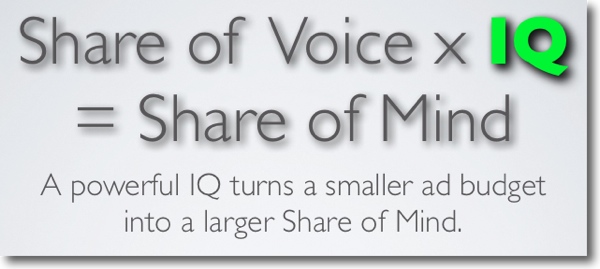
Share of Voice x Impact Quotient = Share of Mind

That's the first sub-formula in the Advertising Performance Equation. If you want to learn more about the rest of the equation, just sign up for my email list. You'll be the first to know about an exclusive learning opportunity!

Create a Company Culture…Start Now!

Home_12

I'm not big on year-end resolutions, big plans and the like. But, I have to share a post from my friend Rich Christiansen.

I've written about Rich before. He wrote "Bootstrap Business" and is an SEO and Adwords expert.

In his latest post on the Bootstrap blog, Rich talks about his relationship with Ray Noorda, founder of Novell. It's a cool story about how one man formed a strong company culture by his own leadership through story, connection and love.

This is a list of qualities that Rich took away from Noorda's funeral…

  • Believe and trust in people.
  • We all have a responsibility in life. Be faithful to it.
  • Customers first, employees second, shareholders third.
  • Be unassuming.
  • Listen, especially with your heart.
  • Practice integrity.
  • Be loyal.
  • Be true to your own core beliefs, but recognize the need to compromise within parameters that don’t violate those beliefs.
  • Respect the individual, not the title.
  • Marriage is ordained of God, and is your first priority in life.
  • Practice fiscal responsibility.
  • Take care of your health.
  • Willingly forgive others’ mistakes and shortcomings.
  • Retain your dignity, no matter the circumstances.
  • Give something back.

Be sure to go read the entire story on the Bootstrap Business Blog.

Have a Happy New Year!

Nice Try Samuel Adams

"Beer is banned in 13 states!" scream the press releases.

(AP Photo/Charles Krupa) Samuel Adams recently uncorked this year's version of its biennial Utopias beer with lots of hype about the 27% alcohol content that exceeds the legal limit in 13 states.

Wow. You'd think people would be up in arms. You'd expect lawsuits, protesters, speeches from the pulpit, yet I haven't been able to find much negative news about this evil brew.

It turns out that it's not really a beer at all. Technically, yes it is beer. Functionally, not even close. What they've really done is make a sipping cognac out of beer. At $150 a bottle, even the Mothers Against Drunk Driving doesn't have a problem with Utopias, and they are quoted as such in the original press coverage.

In chapter 8 of Tom Wanek's new book, "Currencies That Buy Credibility," he talks about risking your reputation and prestige to buy credibility. In essence, you do something that will cause some of your customers to be repelled while others embrace your brand more tightly than ever.

In the case of the Utopias press, it's a surface-level ploy to seem cutting edge and risky. They want you to be shocked that this is a beer that has been "banned" in 13 states. You should be outraged that it costs $150 a bottle at retail. Yet, when you dig a little deeper…or just blow the marketing dust off the label…you find out that this just doesn't live up to the hype. It's just another bottle of expensive sipping hooch for connoisseurs.

So, how could Samuel Adams ACTUALLY risk reputation and prestige?

They'd have to do something that would actually enrage the MADD crowd. They could put out a beer that's both strong, cheap and easy to guzzle…something that would attract the high school drinker as well as the street bum. They need a beer that would get them written up in BumWine.com for the hallucinatory side-effects of the dangerous secret ingredients.

Give that one a try, Sam.

What's Your Market Share? Do you really know?

How much of the market for your particular product or service do you own?

Mathboy Car dealers, real estate companies and other businesses whose transactions are tracked by the government have it made. They know exactly where they stand. Some businesses have an industry clearing-house that collects such information and shares it with members.

For other local retailers or service businesses, this can be a rather difficult number to calculate with any degree of accuracy.

So, how to keep score?

If you've been in the market for long, you actually know more than you think. I hope these steps help you.

1. Write down every one of your competitors by name
2. Order them from biggest to smallest
3. Estimate their annual billing by your BEST GUESS (you're probably close enough to at least make this a useful exercise)
4. Write this number next to their name
5. Show the list to your sales staff, spouse or managers and ask them to add the competitors that you forgot
6. Place your business and your sales number in its proper place in the list
7. ADD up all the numbers…this is your estimate of Market Potential
8. Divide YOUR number by the TOTAL…this is your MARKET SHARE

If the Market Potential seems like a much smaller number than you thought it would be, you've probably missed a few competitors.

What's the lesson from this exercise?

Now, you have a scoreboard!

All of the businesses listed ABOVE your name are targets! Your goal is to be stealing market share. Study them and learn how you can be better than they are.

All of the businesses BELOW you are either potential acquisitions or potential threats to YOU. They see a target on your back. Don't ignore them.